Does Your AI Voice Tool Really Handle Your Language? How To Test It
The question comes up constantly from creators outside the English-speaking world: does this voice tool actually handle my language, or does it only sound good in English?
It is a fair worry. Most demo reels are in English, most reviews are written by English speakers, and a model that sounds effortless in one language can sound like a satellite navigation system in another. Since narration is the thing viewers judge within about three seconds, getting this wrong wastes a lot of production time.
The honest answer is that support varies enormously – by language, by voice within the same tool, and from one model release to the next. Which means the useful thing is not a list of languages that work. It is a repeatable way to find out for yourself in twenty minutes.
Why this matters more than the feature list
Synthetic narration changed what one person can produce. Before it, a narrated video meant recording yourself, hiring a voice actor, or finding a studio. Now a paragraph of text becomes a finished read in seconds, and a single creator can keep a publishing schedule that used to need a small team.
But that only holds if the voice is good enough that viewers stop noticing it. In your own language you can hear the difference instantly. In a language you are less sure of, or one that is poorly represented in a model’s training data, you can ship something that sounds subtly wrong to every native speaker who presses play.
Most major tools now advertise dozens of languages. Advertised support and usable support are different things.
The five tests
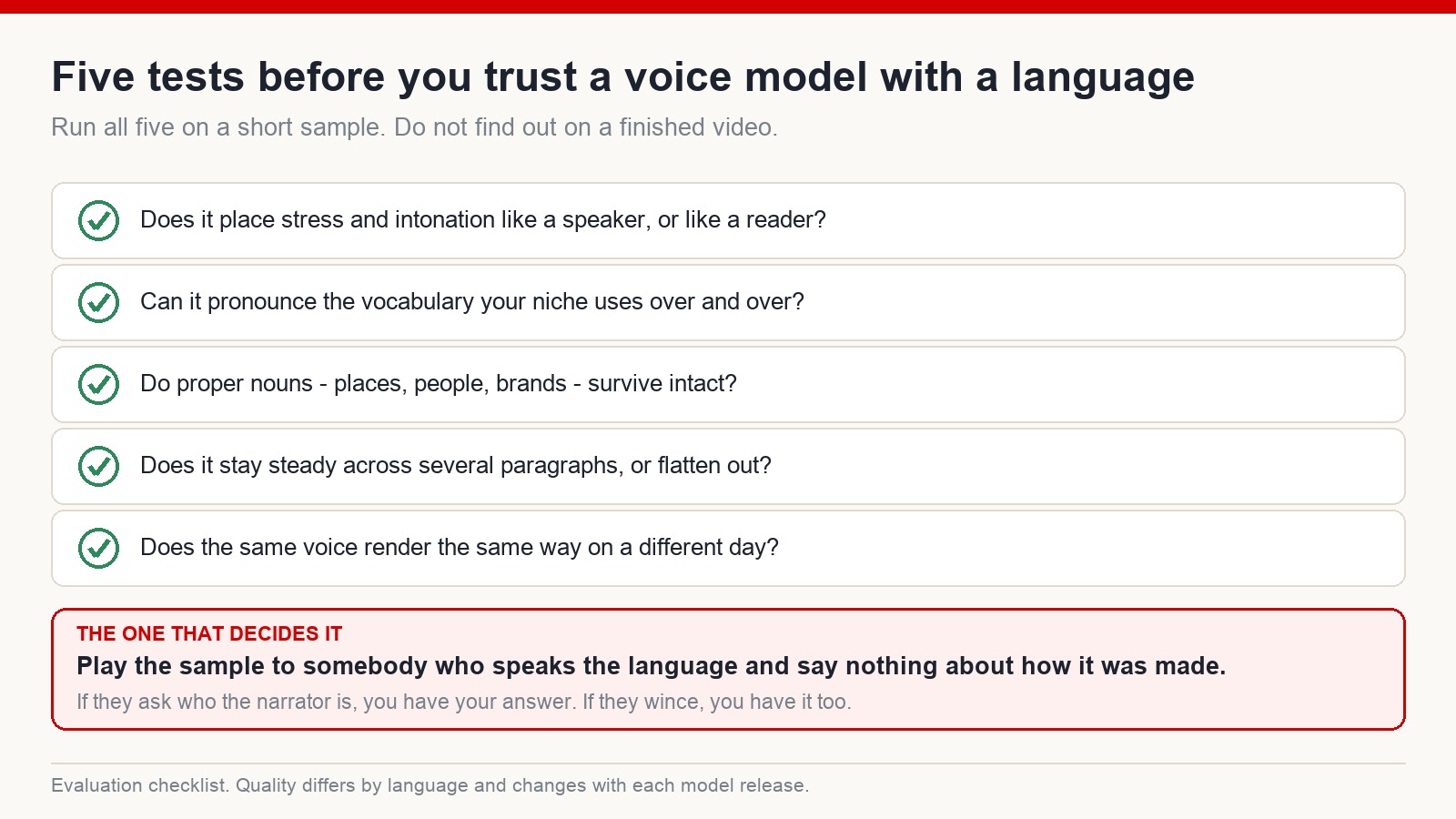
Run these on a short sample before committing to a full video.
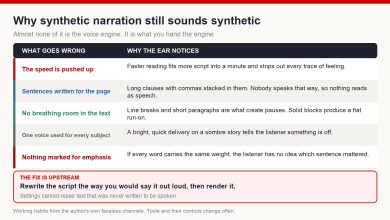
Intonation. Does the voice place emphasis the way a speaker would, or does it read every sentence with the same shape? Flat delivery is the single most common failure in less-supported languages, and it is what makes narration sound machine-made even when the pronunciation is fine.
Niche vocabulary. Every niche has words that recur in every video. If the model mangles one of them, it will mangle it a hundred times.
Proper nouns. Place names, personal names and brand names are where synthetic voices go wrong most often, and they are what viewers comment on.
Endurance. A voice that sounds convincing for thirty seconds can flatten out over eight minutes. Test a passage long enough to hear whether the delivery holds.
Consistency across sessions. Render the same paragraph today and again in a few days. If the same voice comes back noticeably different, your back catalogue will not sound like one channel.
Build one test paragraph and reuse it
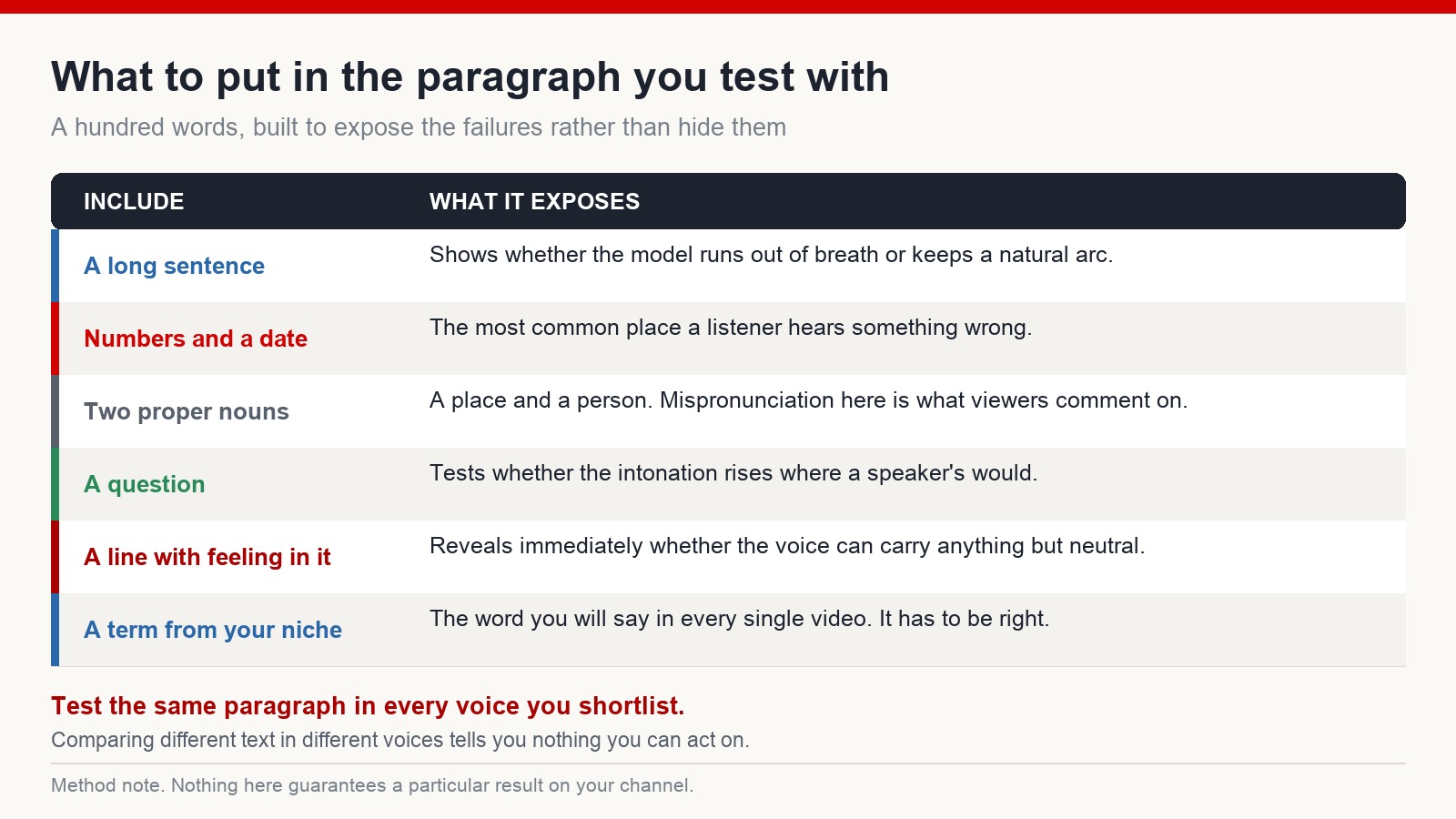
Write about a hundred words containing: one long sentence, a number and a date, two proper nouns, a question, a line with some feeling in it, and a term from your niche. That paragraph is now your standard. Run it through every voice you shortlist and compare like with like – testing different text in different voices tells you nothing you can act on.
Then do the test that decides it: play the sample to somebody who speaks the language natively, without telling them how it was made. If they ask who the narrator is, you have your answer. If they wince, you have that answer too.
Where synthetic narration is already good enough
For most faceless formats – storytelling, explainer content, documentary-style narration, motivational pieces, product breakdowns – current models in well-supported languages clear the bar comfortably. Set up properly, most viewers simply do not stop to think about it.
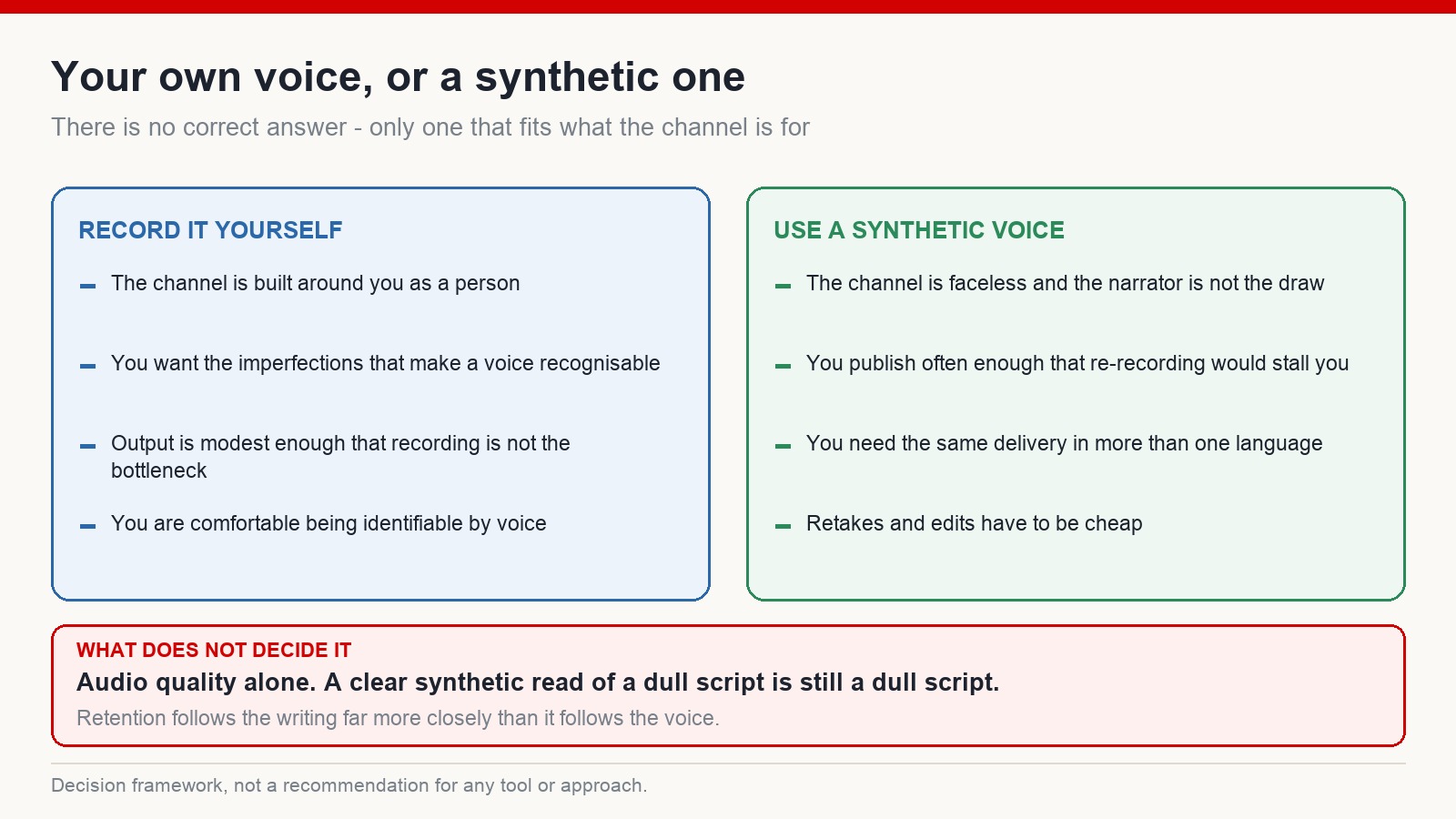
Where it is still short: fine emotional shading, comic timing, and anything where the personality of the speaker is the product. If your channel depends on people liking you, a synthetic voice is solving the wrong problem.
The workflow, once a voice passes
Finish the script first. This is the most common ordering mistake. People open the voice tool with a rough draft and start auditioning voices, then blame the tool when the result drags. A perfect read of a flat paragraph is a flat paragraph, delivered clearly.
Write it to be spoken. Short sentences. Real punctuation. Deliberate line breaks where a thought should land. Prose written for the page comes out sounding like prose written for the page.
Render in sections. Hook, middle, turn, close – separately. Long single renders drift in tone, and sectioning also means a small fix does not cost you a full re-render.
Match the voice to the format. Low and unhurried for reflective or documentary work. Brighter and quicker for short-form. If the choice is between a dramatic voice and a clear one, take the clear one.
Listen to the whole export before you cut. Every time. This is where you catch the mispronounced name, the number read wrong, the sentence that arrives with strange emphasis. Fixing it now takes a minute; fixing it after the edit is built around the audio takes an afternoon.
What the voice does not decide
It is worth saying plainly, because tool discussions tend to inflate their own importance: narration quality is not what makes a video work.
What holds viewers is the idea, the structure, the pacing and whether the thing is worth their time. The voice is a delivery mechanism. It can undermine good writing by sounding wrong, but it cannot rescue writing that has nothing in it. If you are choosing between spending three hours auditioning voices and three hours rewriting the script, rewrite the script.
Frequently asked questions
How do I know whether a tool really supports my language?
Test it rather than trusting the marketing page. Run one standard paragraph through every voice offered in that language, listen for intonation and proper nouns, and have a native speaker listen without being told what it is.
Are male and female voices available in every language?
Usually there is a choice, but the number of voices per language varies a lot. Languages with fewer options also tend to have less range within them, which matters more on long videos than short ones.
Can synthetic narration sound natural in languages other than English?
In well-supported languages, yes, for most content types. Quality drops off in less-represented languages, and it changes with each model release – so retest occasionally rather than assuming last year’s verdict still holds.
Does a synthetic voice affect how a video performs?
Not directly. What affects performance is whether people keep watching. A poor voice in a viewer’s own language will lose them quickly, which is exactly why the testing above is worth the twenty minutes.
The short version
Do not ask whether a tool supports your language. Ask whether this particular voice, in this particular language, survives your own test paragraph and a native speaker’s reaction.
Then spend the time you saved on the script, which is where the actual outcome is decided. If you want a structured route through the rest of the production process, the training system at mmoyoutube.com covers it step by step – with the usual caveat that results depend on niche, effort and consistency rather than on any tool.